
Arcata Is About to Burst
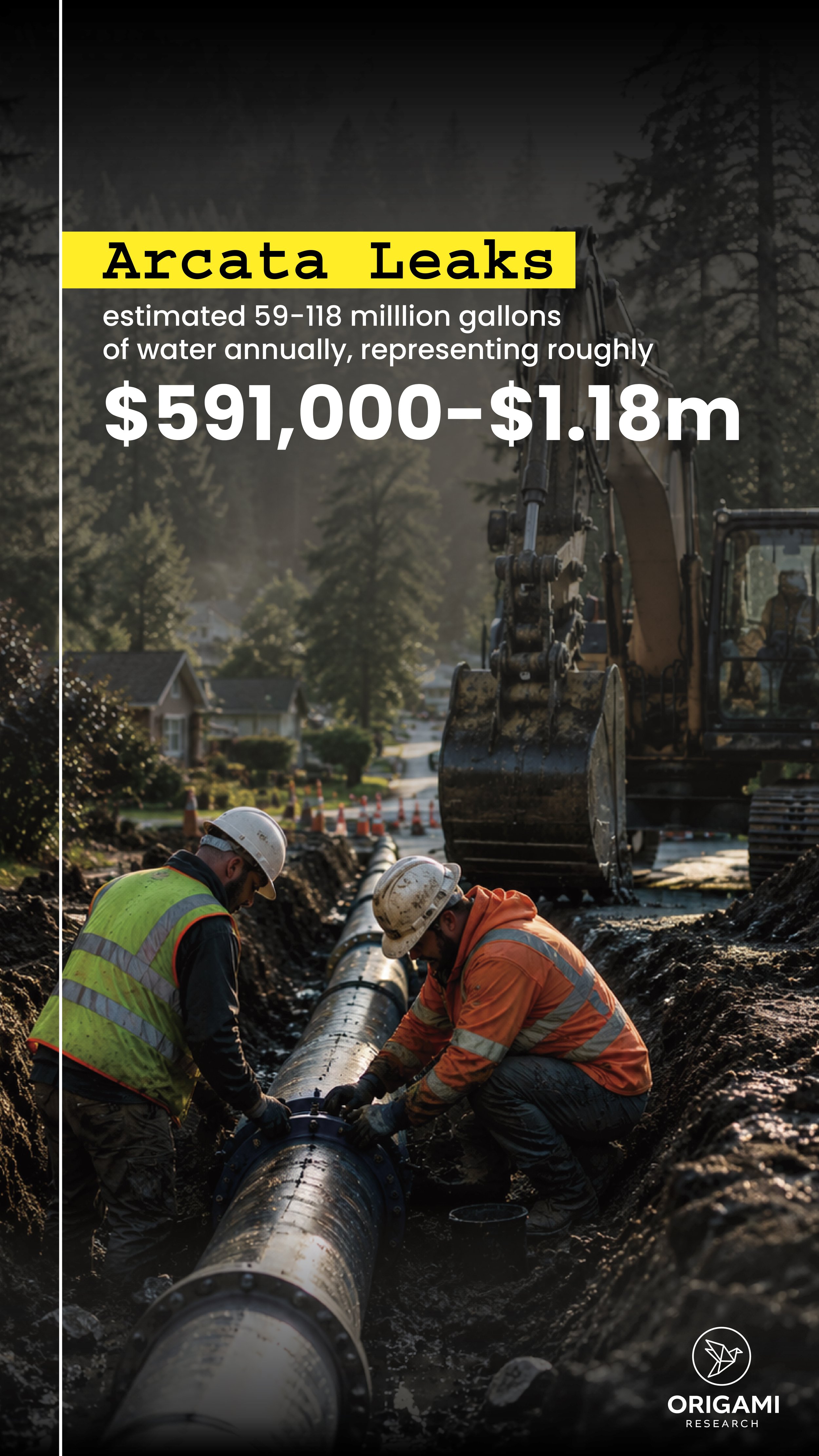
Arcata may be losing an estimated 59-118 million gallons of water every year, representing roughly $591,000-$1.18 million in lost water value annually.
The Problem Beneath Arcata
Arcata's water system is made up of pipes installed over many decades using a variety of materials, some of which are now approaching the end of their useful life.
Not all pipe materials carry the same level of risk. Modern PVC and newer ductile iron systems generally perform well when maintained properly. Older materials such as asbestos cement (AC), cast iron, galvanized steel, and legacy steel water mains are more susceptible to cracking, corrosion, ground movement, and age-related deterioration.
Cast iron is particularly concerning because it is widely recognized as one of the most failure-prone materials still operating in municipal water systems today. Similarly, asbestos cement pipe becomes increasingly vulnerable as it ages, making it a common target for replacement programs across the country.
Arcata has already acknowledged these challenges through an approximately $11 million citywide waterline improvement program focused on aging infrastructure.
Using publicly available infrastructure, roadway, hydrant, school, hospital, fire station, fault-line, fire hazard, and planning data, an AI-assisted screening analysis was conducted to identify locations where future failures could create the greatest community impact.
The following five locations emerged as the highest-priority areas for review.
Priority Area #1 Boyd Road / Valley East Boulevard
The highest-ranked location in the analysis sits along the Boyd Road and Valley East Boulevard corridor in north Arcata. This area contains more than 1,500 meters of mapped water infrastructure, including a significant concentration of asbestos cement pipe. Nearly 1,400 meters of the corridor were classified as higher-risk infrastructure.
The estimated repair cost ranges from approximately $540,575 to $1,235,600, while potential damage exposure could reach nearly $2.9 million. Although the corridor appears to fall within the scope of Arcata's citywide replacement program, no segment-specific replacement schedule was identified.
This area represents the strongest candidate for near-term engineering review.
Priority Area #2 Giuntoli Lane / Valley East Boulevard
Immediately adjacent to the highest-ranked corridor, the Giuntoli Lane and Valley East Boulevard area scored 86 out of 100. The corridor contains extensive asbestos cement infrastructure and nearly 1,000 meters of higher-risk pipe.
Estimated repair costs range from approximately $398,755 to $911,440, while damage exposure could exceed $2.6 million.
Together, Priority Areas #1 and #2 create a notable cluster of elevated infrastructure risk in north Arcata that deserves continued monitoring.
Priority Area #3 LK Wood Boulevard / Foster Avenue
This corridor is particularly notable because it contains one of the few identified cast iron pipe segments found among the highest-ranked locations.
While only a single cast iron segment was identified, its presence immediately elevates concern due to the material's well-documented failure history across municipal water systems. The area also contains substantial asbestos cement infrastructure and nearly 1,500 meters of higher-risk pipe.
Estimated repair costs range from approximately $539,700 to $1,233,600, while potential damage exposure approaches $2.25 million.
Of all locations identified in the analysis, this corridor may warrant the closest material verification efforts.
The Watch Zones
The AI model identified two Watch Zones where three conditions overlap:
Elevated infrastructure risk
Significant financial consequences
No clearly identified replacement schedule
These areas are not predictions of imminent failure.
Instead, they represent locations where risk, consequence, and planning uncertainty intersect.
Watch Zone 1
Watch Zone 1 emerged because it combines elevated damage potential with aging infrastructure and limited evidence of targeted treatment planning.
While portions of the surrounding network may ultimately be addressed through citywide improvement programs, no specific project schedule was identified for this area. As a result, it stands out as a potential planning gap deserving additional engineering review.
Watch Zone 2
Watch Zone 2 exhibits a similar pattern. The area scored highly for both consequence exposure and infrastructure vulnerability but does not appear to be directly associated with a clearly defined replacement effort.
These are exactly the types of locations that often escape attention until a failure occurs.
Final Thoughts
Arcata's water system is not failing. In fact, the City is already investing millions of dollars to modernize critical infrastructure. However, infrastructure planning is ultimately a prioritization problem. Resources are limited, while aging assets continue to accumulate beneath the streets.
The goal of this analysis is not to predict the future. It is to identify where risk, consequence, and planning gaps overlap.The highest-value discoveries are rarely the pipes everyone already knows about. The highest-value discoveries are the locations quietly moving toward a problem before anyone is actively looking for one.
Methodology Note
The findings presented in this report are based on publicly available datasets, GIS analysis, infrastructure screening models, and planning documents. The results represent preliminary infrastructure risk indicators and planning observations. They are not engineering determinations, failure predictions, or replacement recommendations. Field verification, utility records, and professional engineering review should be conducted before making infrastructure investment decisions.
Prepared using publicly available infrastructure, planning, and GIS datasets available as of June 2026.
Prepared by Origami Research.